FFR的生理意義是對於某特定流域之心肌,
目前(有大血管狹窄下)血流/最大可能(排除大血管阻力後)血流
Aorta-> coronary artery -> microvasculature -> cardiac vein -> right atrium
在沒有大血管(冠狀動脈)狹窄的情況下主要的阻力在microvasculature(包括arteriole,capilary)
假定分布於某特定流域之心肌,
其冠狀動脈有一段狹窄,該段阻力R,
而微小血管阻力最小值Rc(使用adenosine注射使微小血管充分擴張而達到),
靜脈壓力(Pv)相對極低接近於0
Pa -> R -> P1 -> Rc -> Pv(=0)
基於連通管任意斷面血流F相等 (Pa-P1)/R=(P1-Pv)/Rc=(Pa-Pv)/(R+Rc)=F
R=(Pa-P1)/F ; Rc=(P1-Pv)/F
目前血流F = (Pa-0)/(R+Rc)
最大可能血流Fmax: 當R經處理成為0 => Fmax= Pa/Rc
FFR = F/Fmax= Rc/(R+Rc) = (P1-0)/(Pa-0) = P1/Pa
Pa 可直接由導管測量, P1則需使用特製導線深入冠狀動脈狹窄後方作測量
FFR 若小於 0.75-0.8 表示目前血流僅剩最大血流之 0.75-0.8倍
Rc/(R+Rc)< 0.75-0.8 意即 R/Rc > 0.33-0.25
此時對此狹窄做處理較有可見之效果
那如果有2段狹窄而中間無大分支的狀況
Pa -> R1 -> P1 -> R2 -> P2 -> Rc -> Pv(=0)
(Pa-P1)/R1=(P1-P2)/R2=(P2-Pv)/Rc=(Pa-Pv)/(R1+R2+Rc)=F
R1=(Pa-P1)/F ;R2=(P1-P2)/F ; Rc=(P2-Pv)/F
兩段狹窄總阻力R=R1+R2, 總合FFR為 P2/Pa
R1 FFR(排除R2後)= Rc/(R1+Rc) = (P2-Pv)/(Pa-P1+P2-Pv) = P2/(Pa-P1+P2)
R2 FFR(排除R1後)= Rc/(R2+Rc) = (P2-Pv)/(P1-P2+P2-Pv) = P2/P1
2012年8月31日 星期五

2012年6月4日 星期一
n objects within controlled bilateral vibration interconnected with (n+1) spring coils
n objects within controlled bilateral vibration interconnected with (n+1) spring coils
(all k/m substitutes with k here)
Xi'' = k Xi-1 -2k Xi + k Xi+1
X0, X n+1 were controlled vibration of cos & sin wave
X0 = Gj cos Wj t
Xn+1= Hj cos Wj t
let Xi be linear, Rij cos Wj t + Qij sin Wj t, composed of different j
Xi'' + 2k Xi = (2k-Wj^2)(Rij cos Wj t + Qij sin Wj t) = k Xi-1 + k Xi+1
k R(i+1)j - (2k-Wj^2) Rij + k R(i-1)j =0
consider characteristic kx^2 - (2k-Wj^2) x + k =0 , with x solution a, b
When Wj^2 > 4k => a,b belongs to Real number
Rij = Gj (a^(n+1-i) - b^(n+1-i)) / (a^(n+1) - b^(n+1)) + Hj (a^i - b^i) / (a^(n+1) - b^(n+1))
When Wj^2 =0 => a=b=1
Rij = Gj (n+1-i) / (n+1) + Hj i / (n+1)
When 0< Wj^2 < 4k => a,b belongs to Imaginery number
(Wj^2 - 2k) / 2k +- Wj x (Wj^2-4k)^0.5 /2k
-1 <(Wj^2 - 2k) / 2k <1
=> let cos Y = (Wj^2 - 2k) / 2k, sin Y = Wj (4k - Wj^2)^0.5 /2k
Rij = Gj sin ((n+1-i)Y) /sin ((n+1)Y) + Hj sin( iY) /sin( (n+1)Y)


共振頻率為 W=2(sin (hπ/[2(n+1)])) k^0.5,
當n夠大時,最高頻趨近 2k^0.5
最低頻 2(sin (π/[2(n+1)])) k^0.5,剛好從0點到(n+1)點形成半波長駐波


(all k/m substitutes with k here)
Xi'' = k Xi-1 -2k Xi + k Xi+1
X0, X n+1 were controlled vibration of cos & sin wave
X0 = Gj cos Wj t
Xn+1= Hj cos Wj t
let Xi be linear, Rij cos Wj t + Qij sin Wj t, composed of different j
Xi'' + 2k Xi = (2k-Wj^2)(Rij cos Wj t + Qij sin Wj t) = k Xi-1 + k Xi+1
k R(i+1)j - (2k-Wj^2) Rij + k R(i-1)j =0
consider characteristic kx^2 - (2k-Wj^2) x + k =0 , with x solution a, b
When Wj^2 > 4k => a,b belongs to Real number
Rij = Gj (a^(n+1-i) - b^(n+1-i)) / (a^(n+1) - b^(n+1)) + Hj (a^i - b^i) / (a^(n+1) - b^(n+1))
When Wj^2 =0 => a=b=1
Rij = Gj (n+1-i) / (n+1) + Hj i / (n+1)
When 0< Wj^2 < 4k => a,b belongs to Imaginery number
(Wj^2 - 2k) / 2k +- Wj x (Wj^2-4k)^0.5 /2k
-1 <(Wj^2 - 2k) / 2k <1
=> let cos Y = (Wj^2 - 2k) / 2k, sin Y = Wj (4k - Wj^2)^0.5 /2k
Rij = Gj sin ((n+1-i)Y) /sin ((n+1)Y) + Hj sin( iY) /sin( (n+1)Y)
共振頻率為 W=2(sin (hπ/[2(n+1)])) k^0.5,
當n夠大時,最高頻趨近 2k^0.5
最低頻 2(sin (π/[2(n+1)])) k^0.5,剛好從0點到(n+1)點形成半波長駐波
2012年5月17日 星期四
other
lim k2->k1 (e^(-k2t)-e^(-k1t))/(k2-k1) = - t e^(-kt)

(若E>0,則r1與r2有一個會是負數,只剩一個正數)

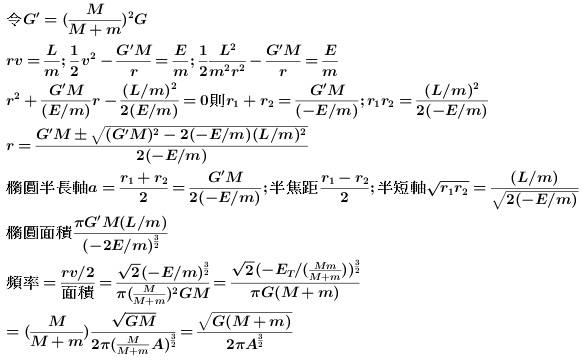
兩星體質量分別為M,m,距離r,以質心為圓心作圓周運動,
a=V^2/R , V=Rw -> a=Rw^2 => w^2=a/R
m之旋轉半徑R為 rM/(M+m), 受萬有引力產生之a為GM/r^2
w^2=a/R= GM/r^2 / (rM/(M+m)) =G(M+m)/r^3
三星體呈正三角,質量皆為m,距離r,以質心為圓心作圓周運動,
旋轉半徑R為 r/3^0.5, 受萬有引力產生之a為Gm/r^2 x 3^0.5/2 x 2 = 3^0.5 Gm/r^2w^2=a/R= G(3m)/r^3
角動量(向量) d [m (r0+r)x(v0+v)] /dt = m(v0+v) x (v0+v) + m(r0+r) x (a0+a) = (r0+r) x (ma0+ma)
當a0=0, F與r同軸 => d [m (r0+r)x(v0+v)] /dt = r0 x ma
兩星體質量分別為M,m,互相萬有引力而不受外界力量,其空間位置向量 r1,r2,質心位置r0
d [M (r0+r1)x(v0+v1) + m (r0+r2)x(v0+v2)] /dt = r0 x (Ma1 + ma2) = 0 (因互為反作用力相加為0)


兩星體質量分別為M,m,距離r,以質心為圓心作圓周運動,
a=V^2/R , V=Rw -> a=Rw^2 => w^2=a/R
m之旋轉半徑R為 rM/(M+m), 受萬有引力產生之a為GM/r^2
w^2=a/R= GM/r^2 / (rM/(M+m)) =G(M+m)/r^3
三星體呈正三角,質量皆為m,距離r,以質心為圓心作圓周運動,
旋轉半徑R為 r/3^0.5, 受萬有引力產生之a為Gm/r^2 x 3^0.5/2 x 2 = 3^0.5 Gm/r^2w^2=a/R= G(3m)/r^3
角動量(向量) d [m (r0+r)x(v0+v)] /dt = m(v0+v) x (v0+v) + m(r0+r) x (a0+a) = (r0+r) x (ma0+ma)
當a0=0, F與r同軸 => d [m (r0+r)x(v0+v)] /dt = r0 x ma
兩星體質量分別為M,m,互相萬有引力而不受外界力量,其空間位置向量 r1,r2,質心位置r0
d [M (r0+r1)x(v0+v1) + m (r0+r2)x(v0+v2)] /dt = r0 x (Ma1 + ma2) = 0 (因互為反作用力相加為0)

2012年5月13日 星期日
2012年5月10日 星期四
multiple step decay
A -k1-> B -k2-> C -k3-> D -k4->E -k5-> F
A'= -k1A; d (lnA)= d(-k1t) ; A=A0 e^(-k1t)
B'= k1A - k2B
B'+k2B=k1A=A0 k1 e^(-k1t);令B(t)=x(t)e^(-k1t)+y(t)e^(-k2t);
> B'(t)+k2B(t) = (k2-k1)x(t)e^(-k1t) + x'(t)e^(-k1t) + y'(t)e^(-k2t) > (k2-k1)x(t)+x'(t) = A0k1 & y'(t)=0 ; y(t)=y0
if k2 = k1 then x'(t) =A0k1; x(t)= A0k1t + x0
>B(t)= (A0k1t + x0)e^(-k1t)+y0e^(-k1t)= A0k1t e^(-k1t)+ (x0+y0)e^(-k1t); B0= (x0+y0)
>B(t)= B0e^(-k1t) + A0k1t e^(-k1t)
if k2 != k1 then x(t) = A0 k1/(k2-k1)
>B(t)= A0 k1/(k2-k1) e^(-k1t)+y0e^(-k2t); B0= A0 k1/(k2-k1) +y0
>B(t)= A0 k1/(k2-k1) e^(-k1t)+ (B0-A0 k1/(k2-k1))e^(-k2t)
>B(t)= B0e^(-k2t) + A0k1( e^(-k1t)/(k2-k1) + e^(-k2t)/(k1-k2) )
C'= k2B - k3C
if k3 != k2 != k1
C(t) = C0e^(-k3t) + B0k2( e^(-k2t)/(k3-k2) + e^(-k3t)/(k2-k3) ) + A0k1k2 ( e^(-k1t)/[(k3-k1)(k2-k1)] + e^(-k2t)/[(k3-k2)(k1-k2)] + e^(-k3t)/[(k1-k3)(k2-k3)] )
IF k1=k2=k3=.........=kn=k AND B0=C0=D0=E0=F0=.........=0 let A1=B, A2=C,.....,An
A=A0 e^(-kt)
A1=B=A0 kt e^(-kt)
A2=C=A0 [ (kt)^2 /2! ] e^(-kt)
A3=D=A0 [ (kt)^3 /3! ] e^(-kt)
A4=E=A0 [ (kt)^4 /4! ] e^(-kt)
A5=F=A0 [ (kt)^5 /5! ] e^(-kt)
An=..=A0 [ (kt)^n /n! ] e^(-kt)
All summation: A0 e^(kt) e^(-kt) = A0
for each An, peak An occured when (An)'=0; (kt/n)=1; tmax = n/k
[n - (n-1)]/[(tmax)n-(tmax)n-1 ] = k ; So The peak wave moves at speed k(let x=kt), (x^n/n!)e^(-x) dx = d[(-x^n/n!) e^(-x)] + (x^(n-1)/(n-1)!)e^(-x) dx,
(-x^n/n!) e^(-x) will be 0(when x=infinite), 0(when x=0,n>0), -1(when x=n=0)
intergration An from x=0 to infinite:
A0[ (kt)^n /n! ]e^(-kt) dt = A0/k[ (kt)^n /n! ] e^(-kt) d(kt) = A0/k (x^n/n!)e^(-x) dx =A0/k[0-(-1)]=A0/k
An= An-1 x ( kt / n )
for each time frame t (and kt), peak A occurred at nmax=kt (where kt/n=1;An=An-1)
at nmax, Anmax-2/Anmax-1= (kt-1)/kt; Anmax+1/Anmax= kt/(kt+1);when kt large enough ->
A'= -k1A; d (lnA)= d(-k1t) ; A=A0 e^(-k1t)
B'= k1A - k2B
B'+k2B=k1A=A0 k1 e^(-k1t);令B(t)=x(t)e^(-k1t)+y(t)e^(-k2t);
> B'(t)+k2B(t) = (k2-k1)x(t)e^(-k1t) + x'(t)e^(-k1t) + y'(t)e^(-k2t) > (k2-k1)x(t)+x'(t) = A0k1 & y'(t)=0 ; y(t)=y0
if k2 = k1 then x'(t) =A0k1; x(t)= A0k1t + x0
>B(t)= (A0k1t + x0)e^(-k1t)+y0e^(-k1t)= A0k1t e^(-k1t)+ (x0+y0)e^(-k1t); B0= (x0+y0)
>B(t)= B0e^(-k1t) + A0k1t e^(-k1t)
if k2 != k1 then x(t) = A0 k1/(k2-k1)
>B(t)= A0 k1/(k2-k1) e^(-k1t)+y0e^(-k2t); B0= A0 k1/(k2-k1) +y0
>B(t)= A0 k1/(k2-k1) e^(-k1t)+ (B0-A0 k1/(k2-k1))e^(-k2t)
>B(t)= B0e^(-k2t) + A0k1( e^(-k1t)/(k2-k1) + e^(-k2t)/(k1-k2) )
C'= k2B - k3C
if k3 != k2 != k1
C(t) = C0e^(-k3t) + B0k2( e^(-k2t)/(k3-k2) + e^(-k3t)/(k2-k3) ) + A0k1k2 ( e^(-k1t)/[(k3-k1)(k2-k1)] + e^(-k2t)/[(k3-k2)(k1-k2)] + e^(-k3t)/[(k1-k3)(k2-k3)] )
IF k1=k2=k3=.........=kn=k AND B0=C0=D0=E0=F0=.........=0 let A1=B, A2=C,.....,An
A=A0 e^(-kt)
A1=B=A0 kt e^(-kt)
A2=C=A0 [ (kt)^2 /2! ] e^(-kt)
A3=D=A0 [ (kt)^3 /3! ] e^(-kt)
A4=E=A0 [ (kt)^4 /4! ] e^(-kt)
A5=F=A0 [ (kt)^5 /5! ] e^(-kt)
An=..=A0 [ (kt)^n /n! ] e^(-kt)
All summation: A0 e^(kt) e^(-kt) = A0
for each An, peak An occured when (An)'=0; (kt/n)=1; tmax = n/k
[n - (n-1)]/[(tmax)n-(tmax)n-1 ] = k ; So The peak wave moves at speed k(let x=kt), (x^n/n!)e^(-x) dx = d[(-x^n/n!) e^(-x)] + (x^(n-1)/(n-1)!)e^(-x) dx,
(-x^n/n!) e^(-x) will be 0(when x=infinite), 0(when x=0,n>0), -1(when x=n=0)
intergration An from x=0 to infinite:
A0[ (kt)^n /n! ]e^(-kt) dt = A0/k[ (kt)^n /n! ] e^(-kt) d(kt) = A0/k (x^n/n!)e^(-x) dx =A0/k[0-(-1)]=A0/k
An= An-1 x ( kt / n )
for each time frame t (and kt), peak A occurred at nmax=kt (where kt/n=1;An=An-1)
at nmax, Anmax-2/Anmax-1= (kt-1)/kt; Anmax+1/Anmax= kt/(kt+1);when kt large enough ->
2012年3月25日 星期日
雜記
vector a x b : vector a sweeps in direction of vector b creates the area
0=(ai+bj)x(ai+bj)=ab (i x j + j x i)
i x j = - j x i

vector(a,b) moved as vector (c,d) painted green area
green area=blue-yellow=orange-pink=ad-bc

red area = green area

(a,b) & (-b,a) make ad-bc becomes a^2+b^2
(fgh)'= f'gh + fg'h + fgh'
(fg)''=f''g + 2f'g' + fg''
(fg)'''=f'''g + 3f''g' + 3f'g'' + fg'''
Z(x(t),y(t)) ; dZ = Zx dx + Zy dy ; dZx = Zxx dx + Zxy dy : dZy= Zxy dx + Zyy dy
則 ddZ = Zxx (dx)^2 + Zyy (dy)^2 + 2 Zxy dxdy + Zx ddx + Zy ddy (Zxx 表Z對x偏微分2次)
sin(x)=cos(x-pi/2)
cos(x)=sin(x+pi/2)
( f(t)e^(kt) ) '=k( f(t)e^(kt) )+ f'(t)e^(kt)
> f(t)e^(kt) dt= d( f(t)e^(kt)/k )- f'(t)e^(kt) /k dt> f'(t)e^(kt) dt= d( f'(t)e^(kt)/k )- f''(t)e^(kt) /k dt
f(t)e^(kt) dt
= d( f(t)e^(kt)/k-f'(t)e^(kt)/k^2 ) + f''(t)e^(kt) /k^2 dt
= d [(f(t)/k-f'(t)/k^2+f''(t)/k^3+.......+fn-1(t)/k^n) e^kt] + (-1)^n fn(t)e^(kt) /k^n dt
當k=-1 => f(t)e^(-t) dt = d [ -(f(t)+f'(t)+f''(t)+............+fn-1(t)) e^(-t) ] + fn(t)e^(-t) dt
G(t)=f(t)e^(k1t)
> G'(t)--kG(t) = (k1-k) f(t)e^(k1t) + f'(t)e^(k1t)
( ln(1-e^(-x)) )'= 1/(e^x-1)
1/[(x-a)(x-b)]=[1/(x-a)-1/(x-b)]/(a-b)=1/(x-a)/(a-b)+1/(x-b)/(b-a)
1/[(x-a)(x-b)] dx = d ln(x-a)/(a-b)+ d ln(x-b)/(b-a) = d {ln [(x-a)/(x-b)]}/(a-b)
1/[(x-a)(x-b)(x-c)]=[1/(x-a)-1/(x-b)]/(a-b)/(x-c)=[1/(x-a)/(x-c)-1/(x-b)/(x-c)]/(a-b)
= {[1/(x-a)-1/(x-c)]/(a-c) - [1/(x-b)-1/(x-c)]/(b-c)}/(a-b)
=1/(x-a)/(a-c)/(a-b)+1/(x-b)/(b-c)/(b-a)+1/(x-c)/(c-a)/(c-b)
1/[(x-a)(x-b)(x-c)] dx = d ln {(x-a)^(1/(a-c)/(a-b)) (x-b)^(1/(b-c)/(b-a)) (x-c)^(1/(c-a)/(c-b))}
曲率半徑for U(x,y)=k
(UxUy)^2/ (Ux^2 +Uy^2)^(3/2) [Uxx/Ux^2 + Uyy/Uy^2 -2 Uxy/(UxUy)]
曲率半徑為正->凹向原點, 曲率半徑為負->凸向原點,


0=(ai+bj)x(ai+bj)=ab (i x j + j x i)
i x j = - j x i
vector(a,b) moved as vector (c,d) painted green area
green area=blue-yellow=orange-pink=ad-bc
red area = green area
(a,b) & (-b,a) make ad-bc becomes a^2+b^2
(fgh)'= f'gh + fg'h + fgh'
(fg)''=f''g + 2f'g' + fg''
(fg)'''=f'''g + 3f''g' + 3f'g'' + fg'''
Z(x(t),y(t)) ; dZ = Zx dx + Zy dy ; dZx = Zxx dx + Zxy dy : dZy= Zxy dx + Zyy dy
則 ddZ = Zxx (dx)^2 + Zyy (dy)^2 + 2 Zxy dxdy + Zx ddx + Zy ddy (Zxx 表Z對x偏微分2次)
sin(x)=cos(x-pi/2)
cos(x)=sin(x+pi/2)
( f(t)e^(kt) ) '=k( f(t)e^(kt) )+ f'(t)e^(kt)
> f(t)e^(kt) dt= d( f(t)e^(kt)/k )- f'(t)e^(kt) /k dt> f'(t)e^(kt) dt= d( f'(t)e^(kt)/k )- f''(t)e^(kt) /k dt
f(t)e^(kt) dt
= d( f(t)e^(kt)/k-f'(t)e^(kt)/k^2 ) + f''(t)e^(kt) /k^2 dt
= d [(f(t)/k-f'(t)/k^2+f''(t)/k^3+.......+fn-1(t)/k^n) e^kt] + (-1)^n fn(t)e^(kt) /k^n dt
當k=-1 => f(t)e^(-t) dt = d [ -(f(t)+f'(t)+f''(t)+............+fn-1(t)) e^(-t) ] + fn(t)e^(-t) dt
G(t)=f(t)e^(k1t)
> G'(t)--kG(t) = (k1-k) f(t)e^(k1t) + f'(t)e^(k1t)
( ln(1-e^(-x)) )'= 1/(e^x-1)
1/[(x-a)(x-b)]=[1/(x-a)-1/(x-b)]/(a-b)=1/(x-a)/(a-b)+1/(x-b)/(b-a)
1/[(x-a)(x-b)] dx = d ln(x-a)/(a-b)+ d ln(x-b)/(b-a) = d {ln [(x-a)/(x-b)]}/(a-b)
1/[(x-a)(x-b)(x-c)]=[1/(x-a)-1/(x-b)]/(a-b)/(x-c)=[1/(x-a)/(x-c)-1/(x-b)/(x-c)]/(a-b)
= {[1/(x-a)-1/(x-c)]/(a-c) - [1/(x-b)-1/(x-c)]/(b-c)}/(a-b)
=1/(x-a)/(a-c)/(a-b)+1/(x-b)/(b-c)/(b-a)+1/(x-c)/(c-a)/(c-b)
1/[(x-a)(x-b)(x-c)] dx = d ln {(x-a)^(1/(a-c)/(a-b)) (x-b)^(1/(b-c)/(b-a)) (x-c)^(1/(c-a)/(c-b))}
曲率半徑for U(x,y)=k
(UxUy)^2/ (Ux^2 +Uy^2)^(3/2) [Uxx/Ux^2 + Uyy/Uy^2 -2 Uxy/(UxUy)]
曲率半徑為正->凹向原點, 曲率半徑為負->凸向原點,
2007年12月16日 星期日
Optimal respiratory rate to improve CO2 clearance during mechanical ventilation with restricted plateau pressure strategy
Dr.Vieillard-Baron and colleagues described that a increasing respiratory rate from 15 to 30 per minute with fixed plateau pressure (25cmH2O) during mechanical ventilation in patients with acute respiratory failure did not improve CO2 clearance, but produced dynamic hyperinflation, and impaired right ventricular ejection. And we doubt that whether there is a optimal respiratory rate with maximal CO2 clearance and find out how to calculate the optimal respiratory rate.
The end-inspiratory lung volume may be a fixed value in a patient with any given plateau pressure. If we always set plateau pressure as an endpoint of inspiration, we must decrease tidal volume to avoid high plateau pressure when respiratory rate increased and subsequently increased autoPEEP. Thus, tidal volume is not determined by inspiratory phase and is determined by the exhaled volume during expiratory phase.
In 1972, Bergman (2) studied the effect of increasing the mechanical-ventilator rate. Bergman stated, “For any patient, the minimum length of time needed for virtual completion of exhalation could be predicted from measurements of total respiratory compliance and resistance.”. He described it in the equation: V (t) = VO e^(–(1/RC)t), where V (t) is the volume of gas remaining in the thorax at any time in seconds (t) after exhalation, VO is the volume of gas in the thorax above resting expiratory level at the beginning of exhalation, and RC is the time constant for the respiratory system, which includes total resistance and compliance. Bergman showed that even in these normal lungs, gas trapping occurs at moderate increases in RR. To simplify the calculation, we define a variable j = e^(–(1/RC)) in any given patient and equation was transformed to V (t) = VO x j^t
With a given plateau pressure, there was constant V0. With a given patient, there was constant 1/RC and subsequently constant j. Thus, we could calculate the exhaled volume(tidal volume TV) in a given expiratory time(t) and V0.
TV = V0 - V(t) = V0(1- e^(–(1/RC)t)) or V0 (1-j^t)
However, there was no gas exchange in the total dead space(DV) and effective tidal volume(ETV) was calculated as
ETV= TV-DV = V0(1- e^(–(1/RC)t))-DV or V0 (1-j^t)-DV
Although, tidal volume was determined during expiratory phase, a respiratory cycle period(total time TT) includes inspiration time(Ti) and expiration time(t). TT=Ti + t
Thus respiratory rate(RR) = 60 / TT,
minute alveolar ventilation= RR x ETV = 60 x ETV / TT
Thus we must search for the maximal value of ETV/TT for maximal alveolar ventilation.

As illustrated in Fig-1, the slope from point A(-Ti,V0-DV) to any point over Bergman's equation was equal to ETV / TT, and the maximal slope was obtained by tangential line of expiratory curve through point A. When Ti and DV is fixed value, we could easily drawed the point A and obtained the optimal RR for maximal alveolar ventilation. From the data in the article by Dr.Vieillard-Baron and colleagues (1), we calculate optimal RR was approximately 22-23.
To increase respiratory rate from 15 to 30 with restriction of plateau pressure in there article, the total dead space was increased from 309 to 318mL (only 3% increase), tidal volume(TV) decreased from 596mL to 464mL, with expiratory time(t) decreased from 2.7sec to 1 sec and inspiratory time decreased from 1.3sec to 1 sec, inspiratory flow was from 458mL/sec to 464 mL/sec.
As previous described, TV = V0 (1-j^t), and we have 2 pair of (TV, t) data to substitute the equation, 596=V0 (1-j^2.7) AND 464=V0 (1-j).
We obtained V0=608mL and j=0.238, then the equation became TV = 608 x (1-0.238^t)
For nonsignificant change of total dead space and inspiratory flow, we assume the dead space(DV) as constant 310mL, and assumed inspiratory flow as constant 460mL/sec
Inspiratory time(Ti) = TV / inspiratory flow = 608 x (1-0.238^t)/460
TT= Ti + t = 608 x (1-0.238^t)/460 +t
ETV= V0 (1-j^t)-DV = 608 x (1-0.238^t) -310
Thus we could calculate RR and minute alveolar ventilation.
respiratory rate(RR) = 60 / TT = 60/(608 x (1-0.238^t)/460 +t)
minute alveolar ventilation(MV)= RR x ETV =60*(608*(1-0.238^t)-310)/(608*(1-0.238^t)/460+t)
With different expiratory time(t), we got different pairs of (RR, MV) and sketched figure 2. As illustrated in Figure 2, we found that maximal alveolar ventilation was 5114.2mL when expiratory time(t) was 1.479 sec, when TT was 2.64sec and RR was 22.7/min.
As in our mathematical model using data from article by Dr.Vieillard-Baron and colleagues (1), increase RR from 15 to 30, only increase alveolar ventilation from 4.3L/min to 4.5L/min, but increase RR from 15 to 22.7 may increase alveolar ventilation from 4.3 L/min to 5.1 L/min

REFERENCES
1.Vieillard-Baron A, Prin S, Augarde R, et al: Increasing respiratory rate to improve CO2 clearance during mechanical ventilation is not a panacea in acute respiratory failure. Crit Care Med 2002;30:1407–1412. PMID:12130953
2.Bergman NA: Intrapulmonary gas trapping during mechanical ventilation at rapid frequencies. Anesthesiology 1972;37:624–635. PMID:4652779
The end-inspiratory lung volume may be a fixed value in a patient with any given plateau pressure. If we always set plateau pressure as an endpoint of inspiration, we must decrease tidal volume to avoid high plateau pressure when respiratory rate increased and subsequently increased autoPEEP. Thus, tidal volume is not determined by inspiratory phase and is determined by the exhaled volume during expiratory phase.
In 1972, Bergman (2) studied the effect of increasing the mechanical-ventilator rate. Bergman stated, “For any patient, the minimum length of time needed for virtual completion of exhalation could be predicted from measurements of total respiratory compliance and resistance.”. He described it in the equation: V (t) = VO e^(–(1/RC)t), where V (t) is the volume of gas remaining in the thorax at any time in seconds (t) after exhalation, VO is the volume of gas in the thorax above resting expiratory level at the beginning of exhalation, and RC is the time constant for the respiratory system, which includes total resistance and compliance. Bergman showed that even in these normal lungs, gas trapping occurs at moderate increases in RR. To simplify the calculation, we define a variable j = e^(–(1/RC)) in any given patient and equation was transformed to V (t) = VO x j^t
With a given plateau pressure, there was constant V0. With a given patient, there was constant 1/RC and subsequently constant j. Thus, we could calculate the exhaled volume(tidal volume TV) in a given expiratory time(t) and V0.
TV = V0 - V(t) = V0(1- e^(–(1/RC)t)) or V0 (1-j^t)
However, there was no gas exchange in the total dead space(DV) and effective tidal volume(ETV) was calculated as
ETV= TV-DV = V0(1- e^(–(1/RC)t))-DV or V0 (1-j^t)-DV
Although, tidal volume was determined during expiratory phase, a respiratory cycle period(total time TT) includes inspiration time(Ti) and expiration time(t). TT=Ti + t
Thus respiratory rate(RR) = 60 / TT,
minute alveolar ventilation= RR x ETV = 60 x ETV / TT
Thus we must search for the maximal value of ETV/TT for maximal alveolar ventilation.

As illustrated in Fig-1, the slope from point A(-Ti,V0-DV) to any point over Bergman's equation was equal to ETV / TT, and the maximal slope was obtained by tangential line of expiratory curve through point A. When Ti and DV is fixed value, we could easily drawed the point A and obtained the optimal RR for maximal alveolar ventilation. From the data in the article by Dr.Vieillard-Baron and colleagues (1), we calculate optimal RR was approximately 22-23.
To increase respiratory rate from 15 to 30 with restriction of plateau pressure in there article, the total dead space was increased from 309 to 318mL (only 3% increase), tidal volume(TV) decreased from 596mL to 464mL, with expiratory time(t) decreased from 2.7sec to 1 sec and inspiratory time decreased from 1.3sec to 1 sec, inspiratory flow was from 458mL/sec to 464 mL/sec.
As previous described, TV = V0 (1-j^t), and we have 2 pair of (TV, t) data to substitute the equation, 596=V0 (1-j^2.7) AND 464=V0 (1-j).
We obtained V0=608mL and j=0.238, then the equation became TV = 608 x (1-0.238^t)
For nonsignificant change of total dead space and inspiratory flow, we assume the dead space(DV) as constant 310mL, and assumed inspiratory flow as constant 460mL/sec
Inspiratory time(Ti) = TV / inspiratory flow = 608 x (1-0.238^t)/460
TT= Ti + t = 608 x (1-0.238^t)/460 +t
ETV= V0 (1-j^t)-DV = 608 x (1-0.238^t) -310
Thus we could calculate RR and minute alveolar ventilation.
respiratory rate(RR) = 60 / TT = 60/(608 x (1-0.238^t)/460 +t)
minute alveolar ventilation(MV)= RR x ETV =60*(608*(1-0.238^t)-310)/(608*(1-0.238^t)/460+t)
With different expiratory time(t), we got different pairs of (RR, MV) and sketched figure 2. As illustrated in Figure 2, we found that maximal alveolar ventilation was 5114.2mL when expiratory time(t) was 1.479 sec, when TT was 2.64sec and RR was 22.7/min.
As in our mathematical model using data from article by Dr.Vieillard-Baron and colleagues (1), increase RR from 15 to 30, only increase alveolar ventilation from 4.3L/min to 4.5L/min, but increase RR from 15 to 22.7 may increase alveolar ventilation from 4.3 L/min to 5.1 L/min

REFERENCES
1.Vieillard-Baron A, Prin S, Augarde R, et al: Increasing respiratory rate to improve CO2 clearance during mechanical ventilation is not a panacea in acute respiratory failure. Crit Care Med 2002;30:1407–1412. PMID:12130953
2.Bergman NA: Intrapulmonary gas trapping during mechanical ventilation at rapid frequencies. Anesthesiology 1972;37:624–635. PMID:4652779
訂閱:
文章 (Atom)